Will AI Replace Freelancers? What the Data Actually Says
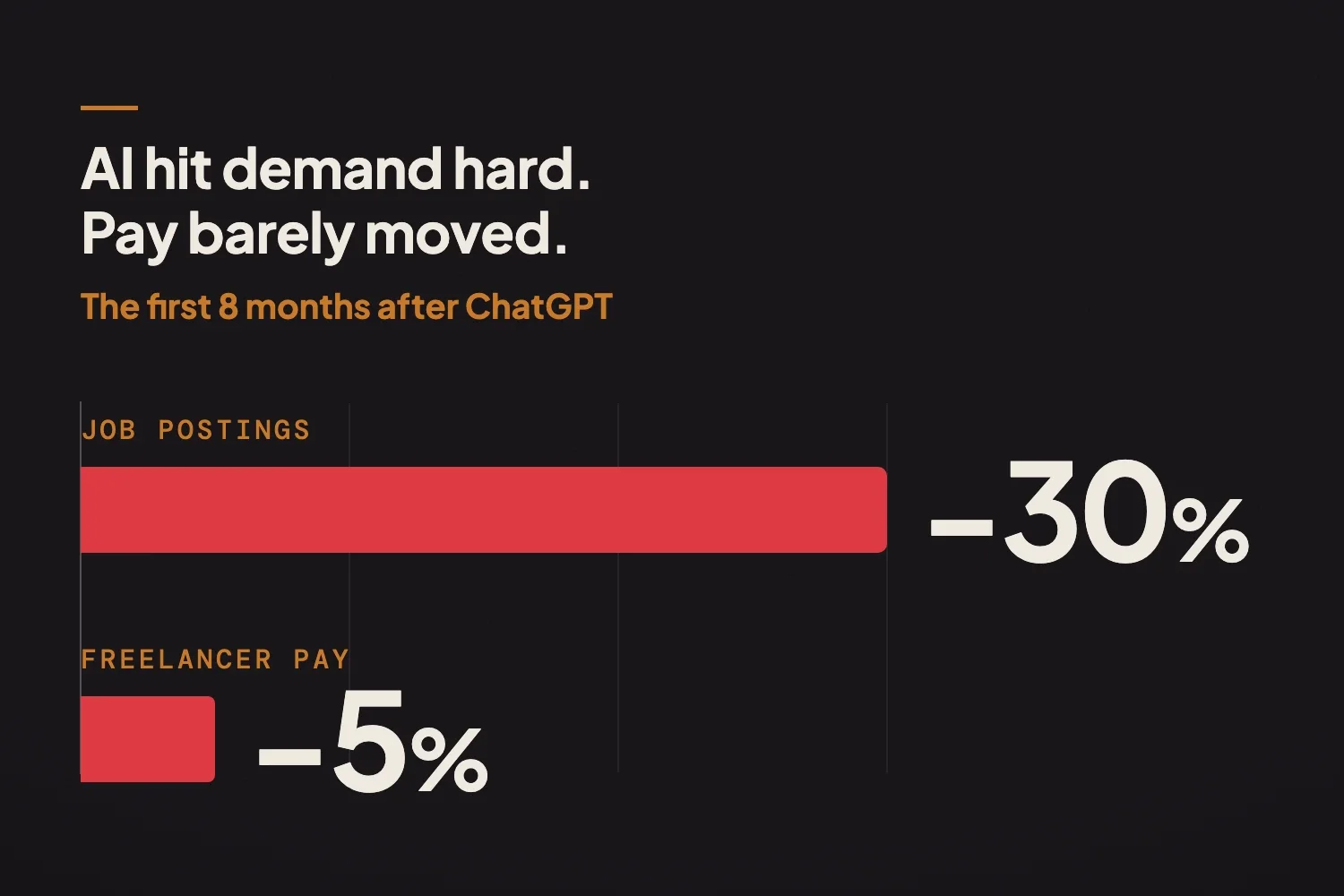
Postings for promptable freelance work fell as much as 30% after ChatGPT. Measured pay fell about 5%. What lives in the gap between those numbers is a map of where the whole profession is going - and a plan for standing on the right side of it.
Brendan Coots
Founder, Freelance Mentors · Updated August 2026 · 11 min read
Go looking for a straight answer about AI and freelance work and you’ll mostly find two kinds of posts: the obituary, where a freelancer’s pipeline dried up and the whole profession is pronounced dead, and the victory lap, where somebody’s AI-assisted workflow has them earning more than ever. Both are describing something real. But neither is describing the market.
I’ve freelanced for 25 years, riding many waves of technology that were supposed to end both my chosen profession (3D animation) and freelancing as a whole. That history makes me skeptical of obituaries, but here’s the truth as I’ve observed it - some freelance work genuinely is disappearing, and probably faster than most people expected. What I want to do is put the actual numbers side by side, because once we do, the picture stops being scary and starts being useful.
Here’s the short version. AI is splitting knowledge work into two piles: work that can be fully specified in advance, which is getting cheaper and more crowded, and work that takes enough judgment that a human has to own it, which is holding its value and, in places, gaining. That split is showing up across the entire economy - in salaried jobs, at agencies, in direct-client work - and freelancers are simply one of the places you can see it in hard numbers. The dividing line runs through what you sell, not how good you are. And you CAN move to the other side of it.
None of this is really about freelancing
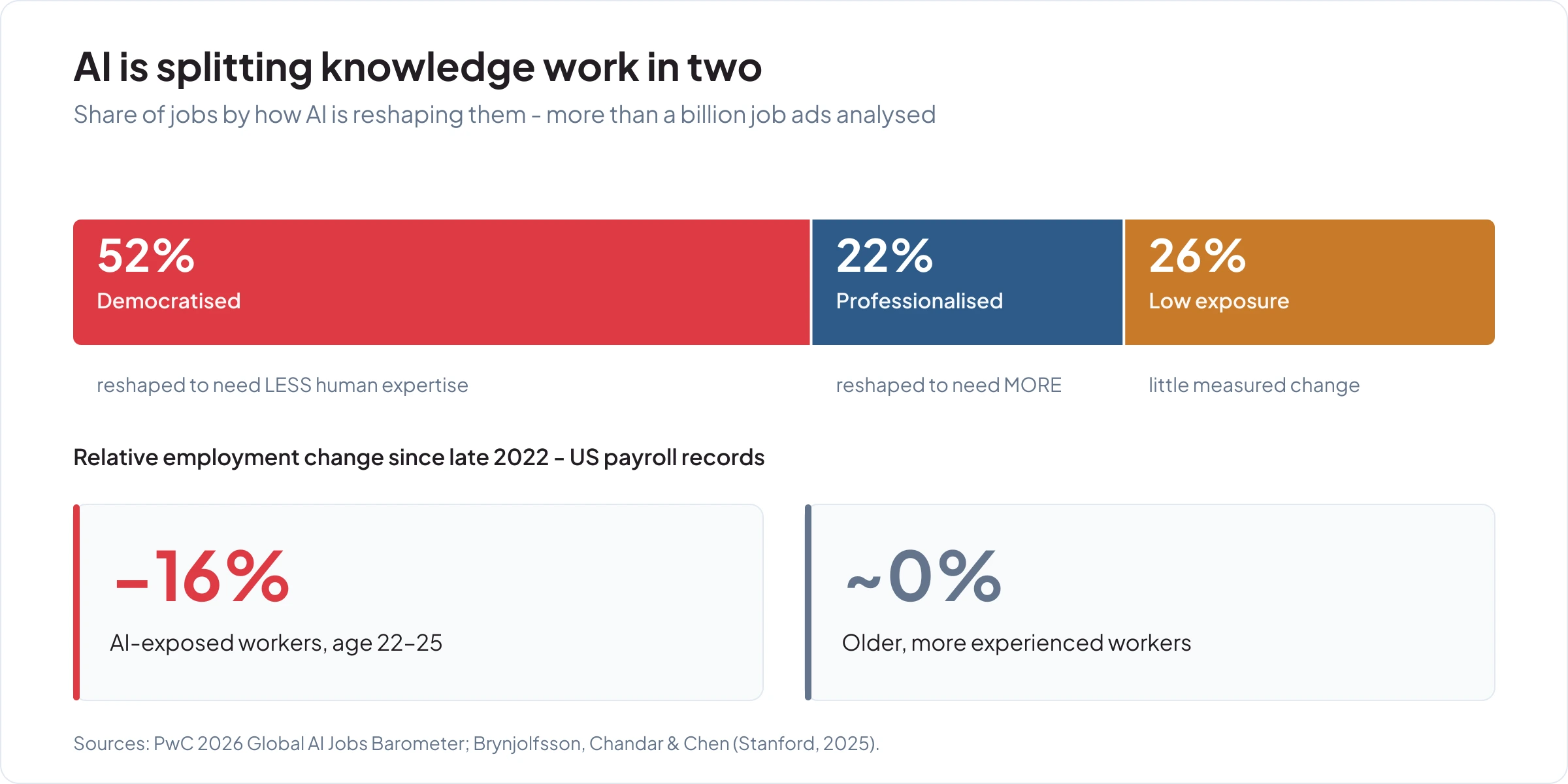
Start with the biggest picture, because it reframes everything underneath it. Researchers at Stanford went through actual US payroll records and found that since late 2022, workers aged 22 to 25 in the most AI-exposed occupations saw their employment fall about 16% relative to workers in the least-exposed jobs - after controlling for the ordinary ups and downs at individual companies. For everyone older and more experienced, the effect was small and statistically hard to distinguish from zero. Same tools, same industries. Sadly, the young and less experienced absorbed the hit; the older and more experienced workers barely felt it.
Two details from that study matter more than the headline. First, the damage didn’t track how exposed a job was to AI - it tracked whether AI did the work or merely helped with it. Occupations where AI performs the task itself shed young workers; occupations where AI just makes a skilled person faster kept growing. Second, in salaried work the adjustment came through headcount, not pay: some people lost jobs, but the ones who kept theirs didn’t see their salaries cut. It’s the mirror image of what happened in freelancing - pay moved instead of headcount - and the two halves together explain the whole thing.
Now let’s zoom out to the global job market - PwC analyzed more than a billion job ads and sorted them by what AI is doing to each role. Their finding: 52% of jobs are being “democratized” - reshaped to need less human expertise - against 22% being “professionalized,” reshaped to need more. Deskilling is running more than twice as fast as upskilling. And the mechanism behind it is old and well understood: when a job needs less expertise, more people can do it, so the work can grow even as its price falls. More work, worth less.
The split runs through the whole economy, not just freelancing. Sources: PwC 2026 Global AI Jobs Barometer; Brynjolfsson, Chandar & Chen (Stanford, 2025).
Put those together and you understand the whole thing before we’ve said the word “freelancer” even once. On one side, work that can be easily specified and automated is getting cheaper, more crowded, and done by (or with) a machine. On the other, work that takes enough judgment that a person has to stand behind it is holding its value, sometimes even gaining. That’s the terrain.
So what does this mean for you?
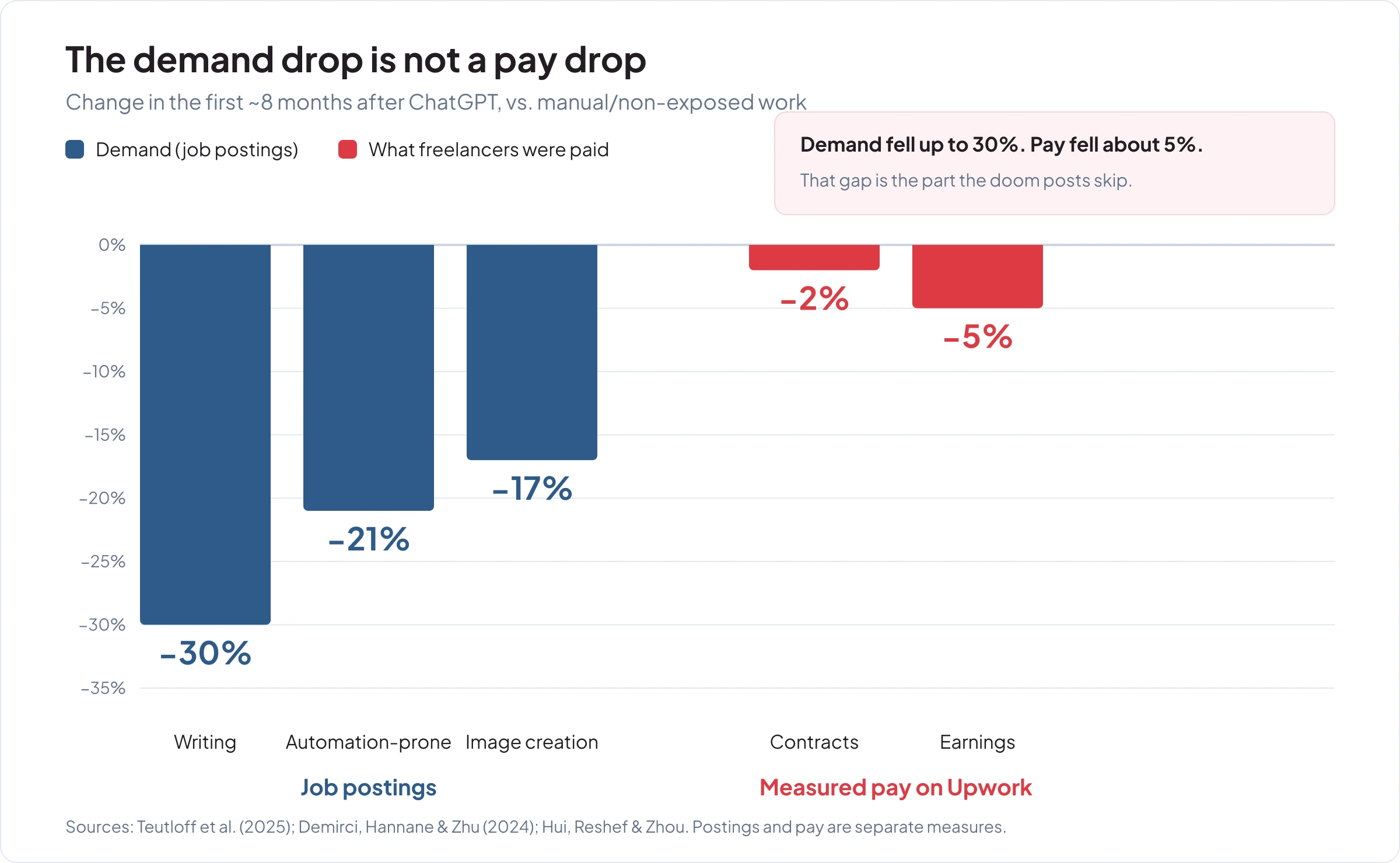
On the major gig platforms, two academic teams found that within about eight months of ChatGPT, postings for writing work fell just over 30% relative to manual work, with substitutable skills as a group (writing, translation) down 20 to 50%, automation-prone categories like routine coding about 21%, and image creation about 17%. Those are declines in postings - in demand for a certain kind of gig. They are not declines in what freelancers got paid. When a third team measured pay directly, the effect on Upwork was roughly 2% fewer contracts and about 5% lower earnings.
The gap between a 30% drop in postings and a 5% drop in pay is the part the doom posts skip. Sources: Teutloff et al. (2025); Demirci, Hannane & Zhu (2024); Hui, Reshef & Zhou.
A 30% demand drop producing a 5% pay reduction looks like a strange contradiction until you ask which transactions vanished. They were overwhelmingly the small, fully-specified ones - the gigs a buyer could describe completely in advance. When a buyer can spell out the whole deliverable in a paragraph, that paragraph has instead become an AI prompt. The work that couldn’t be pinned down that way kept getting bought, from us humans, at close to the same rates.
And here’s the part that matters for your business - this isn’t a gig platform phenomenon. The same line runs through every channel a freelancer works in. An ad agency deciding whether to hand a subcontractor a basic production task or a genuine creative problem. A direct client emailing you a brief they could have pasted into Claude, versus one who needs you to figure out what they actually need. A retainer-based consulting relationship where the value was always the judgment, not the deliverable. The question is identical everywhere: could this be fully specified before I start? If yes, it’s exposed - wherever it’s sold, whoever’s buying. If the answer is no, perhaps it isn’t. This isn’t decided by your talent. What you sell decides it.
Plenty of freelancers watching this unfold describe the same mechanism. One freelancer on Reddit summed up the situation on gig platforms pretty well:
…the people still doing well there aren’t really selling ‘writing’ anymore, they’re tying it directly to outcomes, like traffic, rankings, conversions.
That’s the whole thing, reported live from inside the blast zone. AI didn’t come for freelancers. It came for tasks - and if what you sell is tasks…
Where it hits hardest: the gig platforms
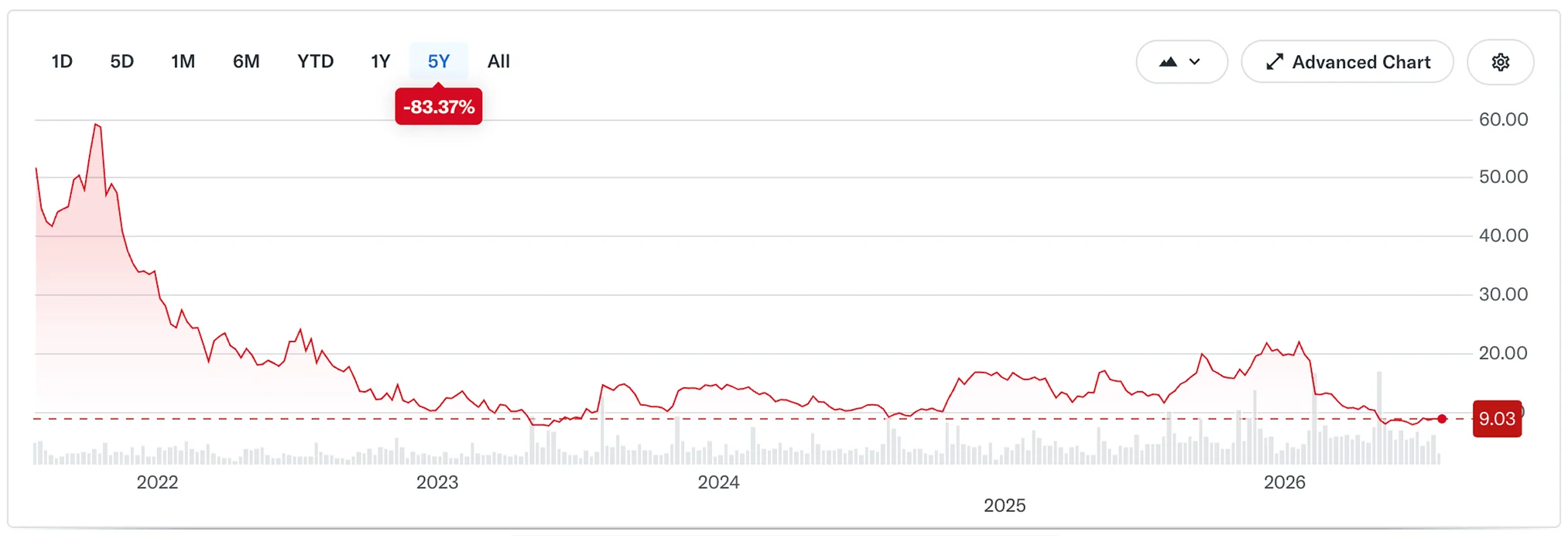
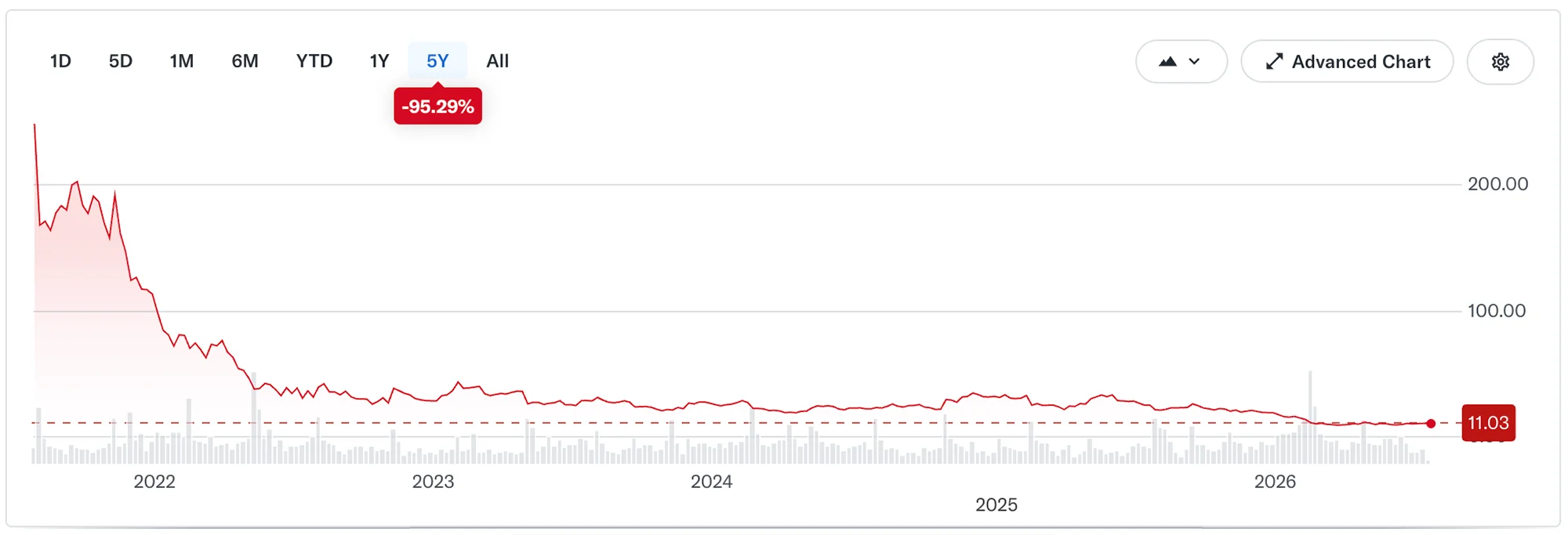
If the split runs through the entire market, it cuts deepest on the gig platforms. A gig-platform listing is, by design, a description of work complete enough that a stranger anywhere on earth can deliver it to spec. That’s the very definition of an AI prompt. The platforms spent a decade industrializing exactly the kind of easily defined, easily compared, commoditized work AI turned out to be best at. So when AI arrived, it landed on those platforms first and hardest. The market has had its own doubts about that model for a while now: as of this writing Upwork trades more than 80% below its 2021 peak, and Fiverr more than 95% below its own. That slide started before ChatGPT did, and it hasn’t reversed since.
Upwork, five-year price. The decline begins in 2021, well before ChatGPT.Fiverr, five-year price. Same pattern, steeper fall.
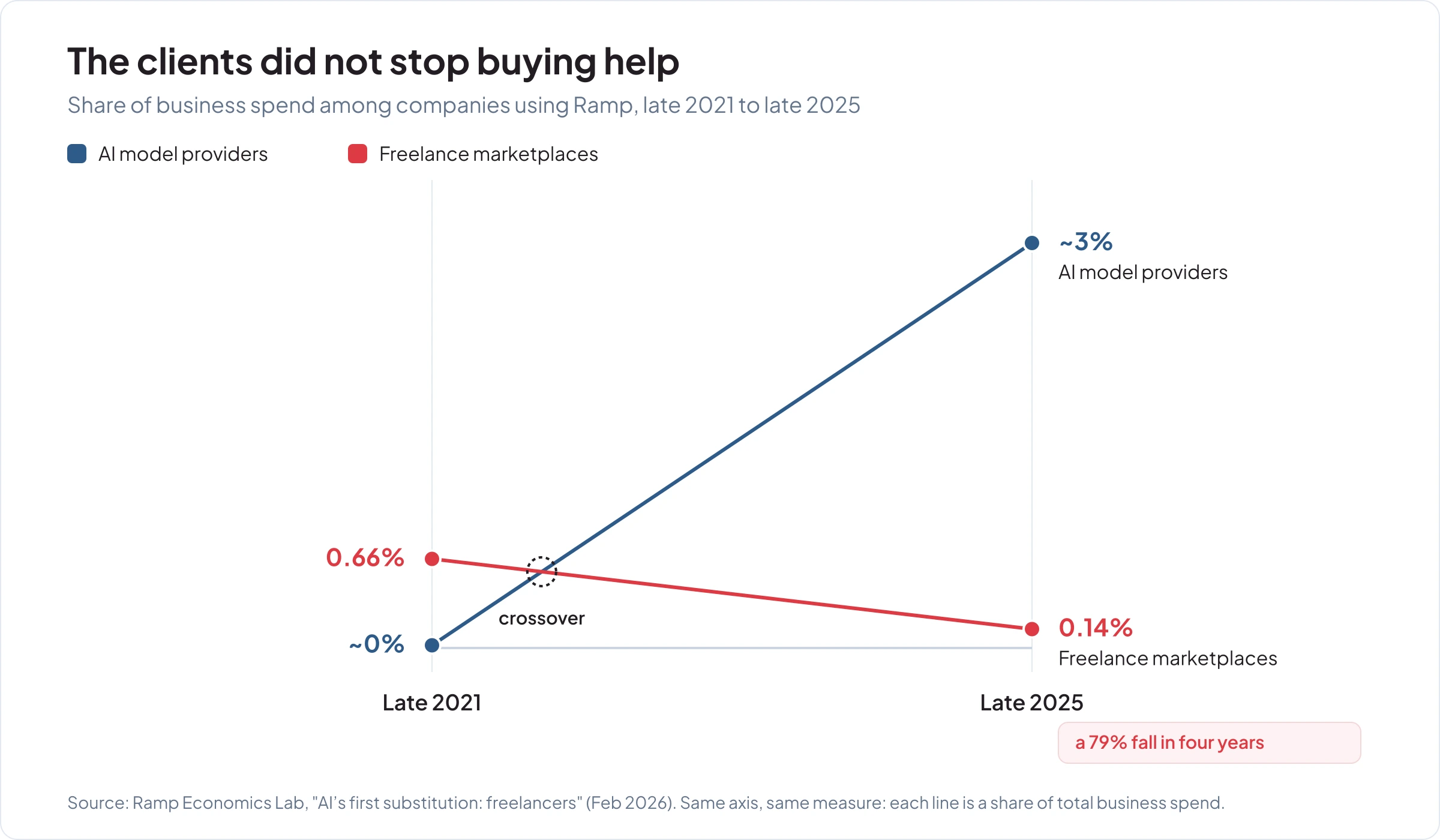
You can watch the money reroute. Ramp’s economics team tracked its own corporate-card and bill-pay data and found that among those companies, spending on gig platforms fell from 0.66% of business spend in late 2021 to 0.14% by late 2025 - while spending on AI providers rose from essentially zero to about 3%. The clients didn’t stop buying help. They started buying a different kind of help for the commodity work.
Client spend rerouted from marketplaces to AI providers. Source: Ramp Economics Lab, February 2026.
The platforms’ own filings show the tide going out: Upwork’s active clients slid from 832,000 at the end of 2024 to 784,000 by early 2026, and Fiverr’s annual active buyers fell 13.6% in a year to 3.1 million (though the buyers who remain spend more each). For a freelancer bidding on these gig platforms, that’s a smaller pond with just as many people fishing. Upwork itself may end up fine. Whether you’ll be fine on Upwork is a different question.
Then came the second hit: the noise-to-signal ratio. AI made a well written, convincing-looking proposal easy and free to produce, so proposals flooded in at industrial scale. One client said this on Reddit, after posting a single job: “I just put out a job req, 99% of answers to ten questions were AI generated.” Job posts are increasingly AI-written, profiles and portfolios are faked wholesale, and buyers cope the only way they can - by distrusting anything that reads synthetic. One freelancer on Reddit summed up where the spiral ends:
Somebody will post an AI posting using Claude. Somebody else will respond using Claude. Then the person will do the work using Claude.
Which is funny, but it’s also our opening. When fake sincerity becomes free, verified humanity becomes valuable - and buyers everywhere, on the platforms and off, are now actively hunting for proof that a real person with real judgment is on the other end. For a freelancer willing to be that person, the noise is a gift. We cover this in detail in the Summit Program.
What the data still can’t tell you
One honest caveat, because you’ll meet confident claims in both directions and most of them are built on thin air. Nearly everything measured with real rigor about AI and freelancing comes from the platforms themselves, and for this reason: researchers need transaction logs, and only the platforms have them. For the much larger world of freelancers who work off the platforms - direct clients, agency subcontractors, retained consultants, the roughly 58% of independents who don’t primarily use platforms at all - there’s essentially no hard data on what AI has done to their incomes. The big survey of that group measures how many of them use AI, not what it’s done to their pay. So when someone tells you AI has gutted independent professionals, or created riches, ask where the number comes from. Right now, nobody has actually measured it and I’d rather tell you that plainly than pretend the map is complete.
What’s actually growing
Plenty. On Upwork’s own marketplace the split shows up right in the pay data: the platform reports that “generative AI and creative production” work saw contract starts jump 90% in a year - while per-contract earnings on that same work fell 13%. More jobs, less money each; commoditization, measured. Meanwhile the more complex, AI-augmented professional work moved the other way, with earnings rising. And Upwork published that split about its own marketplace, against its own interest. That’s usually a sign the numbers are real. Demand for AI-referencing skills on the same platform grew 109% year over year. The work didn’t vanish. It moved up a level, from producing the thing to specifying it, correcting it, and owning the result.
Off the platforms, the independent workforce is growing at its high end: a record 5.6 million US independents now earn over $100,000 a year, up 86% since 2020 (MBO Partners). That’s a workforce trend, not something anyone has tied to AI, so I won’t - but it’s not the look of a dying profession. About three-quarters of independents say they already use AI in their work, and most of them, again, aren’t relying on a gig platform to find that work. Demand for contract creative talent is holding up too: a recent Robert Half survey found 55% of marketing and creative leaders planning to increase contract or temporary hiring - driven by skills shortages, not by AI.
And if the fear is that a client will simply swap you for ChatGPT, the people running those companies mostly haven’t figured out how to make AI pay yet. In PwC’s survey only 8% of CEOs reported more than a slight revenue bump from AI, and a fifth of companies are capturing nearly three-quarters of what value there is. The “just use AI instead of hiring someone” future is far less a reality than the hype implies, and it tends to arrive last for the messy, specific, judgment-heavy problems that were your best approach to freelancing anyway.
How do you make your freelance business AI-resistant?
Three moves, in order of leverage.
1. Change what you sell. Run your offer through one test: could a stranger specify your deliverable in a paragraph without naming your industry? If yes, you’re selling a task, and you’re competing with a prompt window. The fix is the same niche > solution > productized offering work that has separated thriving freelancers from struggling ones since long before AI. Pick a specific market, learn its expensive recurring problems, and package your skills as the solution to one of them. Niche Navigator is a Freelance Mentors toolkit built for exactly this - it maps your skills and background to niche industries, uncovers their pain points, and helps to define services designed to address those pain points.
2. Put AI on the correct side of your desk. AI is an excellent research assistant: company briefings before a call, industry mapping, spotting a prospect’s operational symptoms, structuring your notes. This is where AI genuinely helps freelancers - it compresses hours of homework into minutes. But my advice is to avoid using AI for any and all client interactions. No AI proposals, no AI outreach, no AI check-in messages. You can’t delegate the beginning of a relationship to a machine without the relationship noticing. One freelancer ran the experiment for all of us: “When I started I used AI to churn out proposals but I decided to stop and write them personally and have had way more responses even though I actually send less proposals.” The division of labor is simple and permanent: AI researches the client. You talk to the client.
3. Sell where being human is verifiable. Direct relationships - referrals, repeat clients, and a small number of genuinely researched approaches to companies you understand - were already the highest-margin way to run a freelance business. The noise made them the highest-leverage way too. In an inbox full of AI-generated sludge, twenty minutes of real homework reads like a hand-delivered letter, and buyers have never been better at spotting the difference. Most of your competition automated themselves into the spam folder and called it efficiency. Their loss is quite literally your opening.
Here’s my take on all of it. AI took a real bite out of freelance work, but nearly all of it came out of promptable tasks and the marketplaces built to sell them - and the market clearly has its doubts about that model, having wiped out the large majority of both platforms’ peak stock value. Meanwhile, pay across the broader freelance landscape barely moved, the solution-selling end is growing, and the flood of synthetic noise made genuine human judgment more conspicuous, not less. Which side of the line you land on comes down to what you sell, and that part is entirely in your control. Selling solutions to a relatively narrow market’s problems has been the right move for the 25 years I’ve been doing this. AI didn’t change that answer. It changed the price of ignoring it.
Frequently asked questions
Will AI replace freelancers?
The measured evidence points to AI replacing specifiable tasks, not freelancers as a class - and the same split runs through all knowledge work, not just freelancing. On the freelance platforms, postings for substitutable work fell 20-50% after ChatGPT while measured pay fell only about 5%. Economy-wide, the employment hit landed on junior and generic roles while experienced workers were barely affected. Freelancers who sell defined deliverables face real displacement; those who sell judgment and outcomes for a specific market show little measurable impact, and demand for AI-adjacent skills is rising.
Which freelance jobs are most affected by AI?
Writing and translation postings fell furthest - roughly 30%, with substitutable skills as a group down 20-50% - followed by automation-prone work like routine coding (about 21%) and image creation (about 17%), per academic studies of the major platforms. The common factor is how completely the work can be specified in advance, not the skill level of the person doing it.
Should freelancers use AI in their own work?
Yes, on the research side: company briefings, industry mapping, call prep, and structuring internal notes. Keep it out of client-facing communication - proposals, outreach, and relationship conversations - because buyers now filter aggressively for synthetic writing, and genuinely human contact has become one of the scarcest signals in the market.
Is freelancing still worth starting in the AI era?
The profession's fundamentals remain strong: independents earning $100,000+ grew to a record 5.6 million in 2025, up 86% since 2020, and 62% of self-employed workers report being highly satisfied with their work versus 51% of traditional employees. The viable entry path has changed, though - it runs through real expertise sold as solutions to a specific market's problems, and it mostly bypasses the gig platforms.
What jobs will AI replace?
The pattern in the research is about tasks, not job titles. Work that can be fully specified in advance is getting cheaper and more crowded; work that takes enough judgment that a person has to own it is holding its value. PwC's analysis of over a billion job ads found 52% of jobs being reshaped to need less expertise against 22% needing more, and Stanford's payroll study found the employment hit landing on workers aged 22 to 25 in the most AI-exposed occupations while experienced workers were barely affected. So the question worth asking about your own work is how much of it a client could describe completely before you start.
Keep climbing
Tools for this stage
Put this into practice with the Freelance Mentors toolkits.
Over the past 25 years I've built a successful freelance business working with a wide range of clients, from small local businesses to massive companies like Apple. Many years ago, I discovered my passion for helping people just like you to build your own thriving freelance business. If you're ready to put in the work, I'm dedicated to helping you succeed.
Next waypoint
Continue the expedition
This article lives in The Freelance Plan, the preparation stage of the expedition.