Gig Platforms
Are Upwork and Fiverr Worth It?
The platforms publish the success stories. The earnings data tells a different story.
Brendan Coots
The platforms publish the success stories. The earnings data tells a different story.
Short answer: for most freelancers, no - and I say that as someone who has freelanced for 25 years without needing either one. But you shouldn't take my word for it, because the case against the gig platforms doesn't rest on anyone's opinion. It rests on earnings data, and a surprising amount of it comes from the platforms themselves. Let's walk through it.
First, credit where it's due. If you're staring at a brand-new freelance business with zero clients, I understand exactly why Upwork and Fiverr look like the safe first move. Finding clients is the part of freelancing that scares people the most, and the platforms promise to handle it for you: the clients are already there, payment is protected, and you can be "in business" this afternoon. That promise is real, as far as it goes. The question is what it costs you - and the answer is scattered across a dozen sources that have little interest in showing it to you in one place.
Before judging the platforms, we need a yardstick. According to the Bureau of Labor Statistics, the median full-time American worker earns $1,235 a week - about $64,220 a year. More relevant for most readers of this site: full-time workers with at least a bachelor's degree earn a median of $1,763 a week, which works out to roughly $92,000 a year.
If you're a skilled professional - a developer, designer, writer, marketer, 3D artist - that $92,000 is your real benchmark, because it's approximately what you give up by not taking a salaried job. "Worth it" means an income somewhere near that bar, with a believable path beyond it. Survival wages don't count as a career.
Here's what makes this analysis interesting rather than depressing: freelancing as a profession clears the bar comfortably.
ZipRecruiter data - which Upwork itself cites in its own resources - puts the average U.S. freelancer's income at $99,230 a year. The distribution behind that average is wide but genuinely encouraging: the 25th percentile earns around $50,500, and the 75th percentile earns around $128,500. More than a quarter of American freelancers are out-earning the typical college-educated employee.
And the high-earning group is growing fast. MBO Partners found that 4.7 million independent workers earned over $100,000 in 2024, up from 3 million in 2020.
So hold onto this: the six-figure freelance career is not a fantasy. It's common, it's growing, and it's measurable. The freelancers earning it are overwhelmingly the ones who find clients through referrals, networks, direct outreach, and reputation - in other words, in the open market. Keep that distinction in mind, because it's about to do a lot of work.
Upwork positions itself as the professional's marketplace, and its scale is genuinely impressive: roughly 18 million registered freelancers and $4.1 billion in annual services volume.
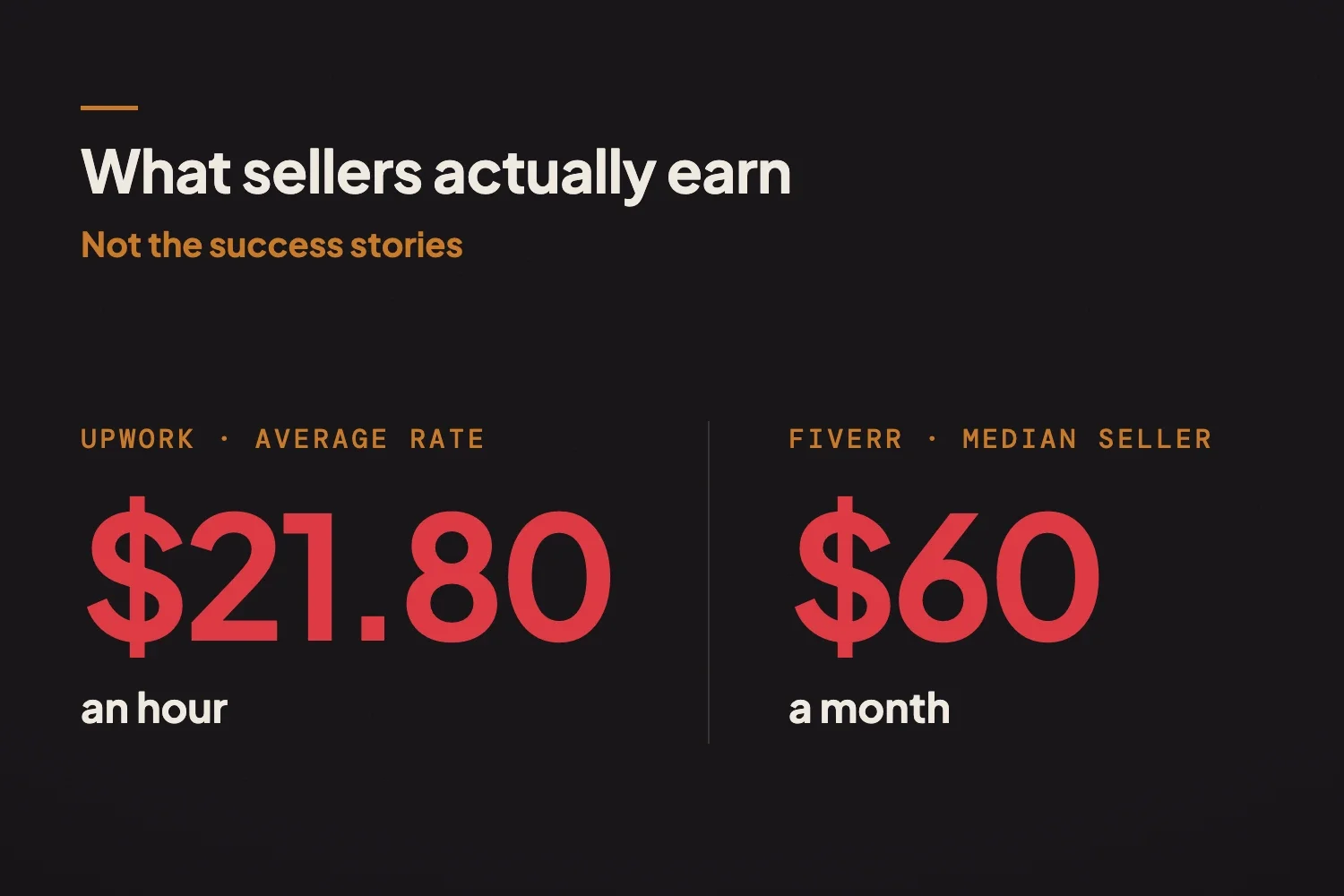
Now the earnings. The reported average rate on Upwork is $21.80 an hour, with some estimates running as high as $39. Take the $21.80 average, book a full-time year at it - 2,080 hours, which almost nobody on the platform actually books - and you gross about $45,000. Before fees. That's half the college-graduate benchmark, for the average participant, under generous assumptions.
The fees make it worse. Upwork currently charges freelancers a variable service fee of anywhere from 0% to 15%, set per contract - a structure it adopted in 2025, replacing the old flat rate. A contract billed at $25 an hour can pay you $21.25 before you've covered a single business expense or tax.
Upwork's own rate guides advertise ranges like $10 to $100 an hour for developers and $15 to $40 for writers. Those upper numbers do the marketing. But when the platform-wide average lands at $21.80, you can guess where most people actually sit inside those ranges.
What about the stars? One industry analysis puts the share of Upwork freelancers earning more than $1,000 a month at roughly 1 in 800. I can't independently verify that figure, so hold it loosely - but even if the truth were ten times better, it would still describe a market where the overwhelming majority can't pay rent from it. Meanwhile the platform showcases its "$1M+ earned" badges and its top one percent. Casinos advertise their jackpot winners for the same reason.
If Upwork suppresses professional wages behind a professional veneer, Fiverr drops the veneer.
The most detailed public look at Fiverr seller earnings comes from a Priceonomics analysis of real income data, and its findings are stark: the median Fiverr seller earns about $60 a month. The average is $104. Seventy percent of sellers earn less than $100 a month, and 96 to 97 percent earn less than $500. That data comes from Fiverr's earlier years - and the platform has only grown more crowded since.
Read those numbers again. For seven in ten sellers, Fiverr produces less money per month than a decent dinner out. This is a marketplace whose very name trained clients to expect five-dollar work, and the pricing culture never left.
The fees compound it. Fiverr takes a flat 20% of everything a seller earns - including tips - and its total take rate climbs past 30% once buyer-side fees are counted.
One genuinely funny data point: ZipRecruiter lists the average "Fiverr Freelance" salary at $130,079 a year. That number can't describe the sellers earning $60 a month, and it almost certainly doesn't - it describes salaried jobs that involve hiring and managing Fiverr freelancers. There is real money in the Fiverr economy. It flows to the people doing the buying, and to the platform. The sellers are the product.
Upwork | Fiverr | |
|---|---|---|
Seller commission | 0% to 15%, set per contract | 20% flat, on everything including tips |
Total platform take | 0% to 15% | Past 30% once buyer-side fees are counted |
Typical earnings | ~$21.80/hr average, about $45,000 a year before fees | Median about $60 a month; 70% earn under $100 a month |
None of this is an accident or a market hiccup. Four structural mechanisms produce these outcomes, and they're worth understanding because they explain why "just try harder on the platform" is bad advice.
1. The platform tax never ends. A fee on every dollar, forever, is a fundamentally different cost than paying to find a client once. Freelancers in the open market pay their acquisition costs up front - almost entirely in the form of time invested - and then keep everything a relationship produces for years. Platform freelancers pay the toll on every invoice, permanently. I'll say this as plainly as I can: I would never hand a third party 20 cents of every dollar I earn plus that much control over my business, and I've never had to.
2. It's the largest competition pool ever assembled. Upwork's talent base spans more than 180 countries. A designer in Denver isn't competing with other Denver designers - she's competing, on the same screen and sorted by price, with skilled designers in cities where $15 an hour is excellent pay. Competing on price in that pool is like entering a limbo contest against people who don't have spines. Economists call this global labor arbitrage. The platforms call it liquidity. Either way, it structurally caps what anyone can charge, and it is the product working as designed.
3. The review system owns you. A 2020 Columbia Business School experiment measured how much Upwork freelancers value their ratings, and the results are quietly devastating: the median freelancer valued a single positive review at about $49, and when researchers offered $175 in cash instead, a third of freelancers still chose the review. Take a moment to consider what that actually means: working professionals turning down real money because the algorithm's opinion of them is worth more than the payment. That fear is exactly what pressures platform freelancers into unpaid revisions, scope creep, and tolerating clients they should fire. In my own business, the only reviews that have ever mattered came in the form of repeat clients and referrals - and nobody can suspend those.
4. You carry an employee's burdens with none of the leverage. Platform freelancers are independent contractors, which means the full 15.3% self-employment tax, no employer health coverage, no paid time off, and no retirement match. The Pew Charitable Trusts found that 41.6% of nontraditional workers have no retirement savings at all. Real independence compensates for those burdens with pricing power. The platforms hand you those burdens while keeping the pricing power for themselves.
Put the four together and you get the treadmill that traps people: price low to win work against global competition, absorb bad client behavior to protect the rating, hand the platform its cut, cover your own taxes and benefits from what's left, and then step straight into the next low bid because nothing about the last one built you an asset. That's the difference between working hard and building something - on a treadmill, the miles never take you anywhere.
There's a paradox here, and the platforms lean on it hard. Pew Research finds that 62% of self-employed workers are highly satisfied with their jobs, versus 51% of traditional employees. Doesn't that suggest the gig economy is working?
Look at who was surveyed. That satisfaction number covers the entire self-employed population - consultants, contractors, and small-business owners, the overwhelming majority of whom built their client base off-platform. App-based gig work is rarely anyone's actual livelihood: Federal Reserve and Pew data indicate that only about 1% of adults earn 90% or more of their income from it. It strains belief that the Fiverr sellers earning under $100 a month are the ones reporting deep career satisfaction.
The platforms are borrowing the reputation of independent professionals to recruit people into a very different economic arrangement. The satisfaction belongs to the business owners. The risk belongs to the platform workforce. They are, for the most part, different people - and which group you join is a decision, made early, that most freelancers never realize they're making.
Here's the reality: if you're brand new and need two or three portfolio pieces, a brief and deliberate stint on a platform is a defensible move. Some clients are real, some reviews transfer to your reputation in spirit if never in form, and eating is important. The mistake is moving in. If you use a platform, set your exit date before you create the account.
The durable move - the one the $99,230 average and those 4.7 million six-figure independents point to - is building a freelance business that owns its three most valuable assets:
Own your niche. Generalists get commoditized heavily by gig platforms, because interchangeable skills get sorted by price. Specialists get found, referred, and paid for expertise. Deciding exactly what you're offering and to whom is the cornerstone of every successful freelance business I've observed in 25 years. That's precisely what our Niche Navigator toolkit helps you to lock in.
Own your price. Most freelancers price by guessing at what the market will bear, which on a platform means racing the global floor. A business prices from its real cost of operating - health insurance, retirement, taxes, equipment, the unpaid hours - upward. If you've never calculated the hourly rate your life actually requires, our Pricing Compass toolkit will show you that number, and it is almost always higher than what a platform would ever let you charge.
Own your client relationships. Direct relationships produce repeat work, referrals, and pricing conversations where your value gets weighed instead of your bid. No fee, no algorithm, no terms-of-service between you and the person paying you.
Is that path more work up front than filling out a gig profile? Yes, and I won't pretend otherwise. But one path builds an asset that compounds, and the other builds a rating on a platform that can suspend you tomorrow. The numbers in this article are what those two paths pay.
Once you own the niche, the price, and the relationship, everything else in freelancing gets easier. That's the business worth building - and it's the one no platform can take a cut of.
For a handful of early portfolio pieces with a planned exit, it can serve a narrow purpose. As a career home, the platform's own average rate - $21.80 an hour before fees - answers the question. Build your direct-client engine from day one, even if a platform pays a few early bills.
The data says almost nobody does: the median seller earns about $60 a month, and 96 to 97 percent of sellers earn under $500 a month. Fiverr functions as a marginal side hustle for the majority of its sellers, at a 20% commission.
Upwork charges a variable 0-15% service fee set per contract. Fiverr takes a flat 20% from sellers on everything including tips, and its total take rate exceeds 30% once buyer-side fees are counted.
Direct client acquisition built on specialization: pick a niche where your skills solve expensive problems, price from your real cost of doing business, and build relationships that produce repeat work and referrals. It's slower to start and dramatically better economics - the average U.S. freelancer earns just under $100k a year, and that population is overwhelmingly off-platform.
Put this into practice with the Freelance Mentors toolkits.



This article lives in Start Freelancing, the first stage of the Freelance Mentors expedition.

More guides and free toolkits to get your bearings on the fundamentals of freelancing.
Return to the hub
The full guided ascent: 120+ lessons, the complete toolkits, and mentorship from first client to thriving business.
Explore the program
My free Saturday morning newsletter delivers freelance wisdom and advice straight from my own personal experience and research.
It’s short and sweet but nutritionally dense - the perfect complement to your weekend morning coffee.
No fluff, no spam. Unsubscribe anytime.