Search "Upwork vs. Fiverr" and the first result is Upwork comparing itself to Fiverr. Most of what sits below it comes from a rival platform, or from sellers so established inside these marketplaces that the squeeze a newcomer feels is invisible from where they stand. I've freelanced for 25 years without using either platform and I earn nothing from your choice, which makes this the comparison neither of them has any interest in publishing.
I'll give you the honest head-to-head first, because if you're weighing these two you deserve a real answer. Then we'll walk through the fee math and the earnings data, because those numbers change what the question even is.
Here's the honest head-to-head: Fiverr fits fast-turnaround, productized services listed at a fixed price; Upwork fits scoped professional projects won on a proposal. Fiverr takes 20% from you plus 5.5% from your buyer; Upwork takes a per-contract 0% to 15%. For most skilled professionals weighing the two, the better long-term move is neither.
The actual differences
How work arrives. Upwork is a proposal marketplace: clients post jobs, you write proposals, and you pay for "Connects" for the privilege of applying. Fiverr inverts it: you list productized gigs at fixed prices and wait for buyers to find you.
Who the clients are. Upwork skews toward businesses with scoped projects and the occasional longer engagement. Fiverr skews toward one-off, transactional purchases from buyers who are shopping on price first.
What they take. At this particular moment, Upwork charges a variable service fee of 0% to 15%, set per contract, plus any Connect fees you paid to land the gig in the first place. Fiverr takes a flat 20% of everything you earn, and charges your buyer a 5.5% service fee on top.
Pricing power. Neither gives you much. Fiverr's gig format anchors prices low because buyers see a wall of near-identical offers sorted by cost. Upwork's proposal pool bids you down because someone with a radically lower cost of living is always in that mix.
If you forced me to pick: Fiverr fits fast-turnaround, productized micro-deliverables you can fulfill in volume. Upwork fits scoped professional projects where a strong proposal can differentiate you, assuming the client is actually reading proposals and not just looking at price.
Now let me show you why I think it's the wrong question.
The fee math, side by side
Upwork retired its longtime flat 10% fee and replaced it with a variable rate - 0% to 15%, set per contract - reportedly in May 2025. The old flat 10% is still widely quoted, so if that's the number in your head, it no longer applies. Under the current structure you don't know your exact cut until a contract is offered, though once it begins the rate is fixed.
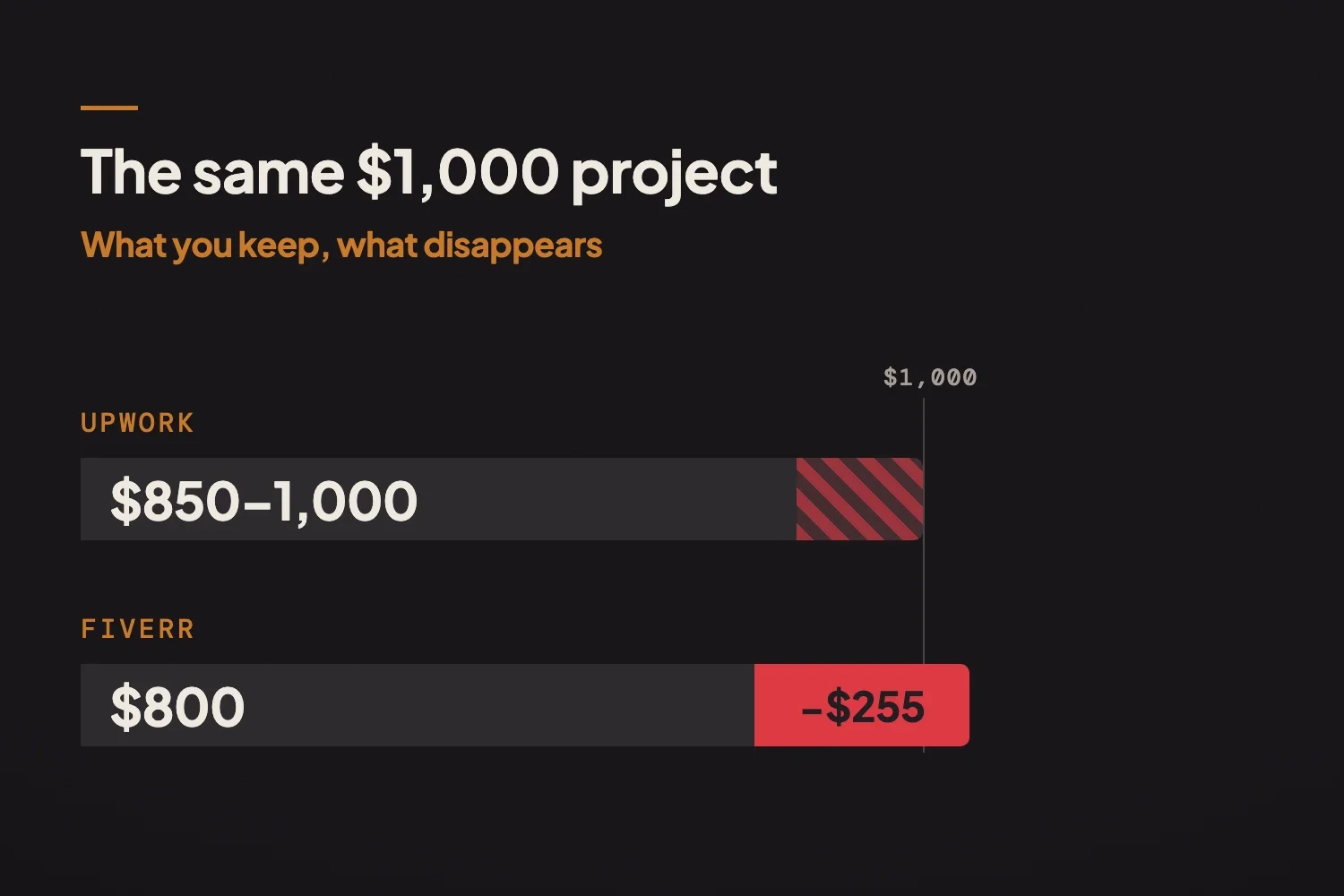
Fiverr is simpler, and harsher: sellers keep 80% of every order, and buyers pay a 5.5% service fee at checkout, plus a small flat fee on low-value orders. Run that on a $1,000 project and the client pays $1,055 while you keep $800 - a $255 wedge between what they spend and what you receive. I would never give a third party 20% of every dollar I earn along with that much control over my business, and I say that having priced client work for 25 years.
| Upwork | Fiverr |
|---|
Seller commission | 0% to 15%, per contract | 20% flat |
|---|
Buyer fee | None | 5.5% at checkout |
|---|
Extra seller cost | Connects (pay to apply) | Flat fee on low-value orders |
|---|
On a $1,000 project | You keep $850 to $1,000 | You keep $800; the buyer pays $1,055 |
|---|
What the earnings data says
A Priceonomics analysis of real income data found the median Fiverr seller makes about $60 a month, and 70% make less than $100. That dataset is from around 2016, before the marketplace got more crowded, so treat it as the optimistic-era baseline.
Upwork's reported average rate is $21.80 an hour, with some estimates running as high as $39. Book a full-time year at the average - 2,080 hours, which almost nobody on the platform actually books - and you gross about $45,000 before fees. One industry analysis puts it at roughly 1 in 800 Upwork freelancers earning more than $1,000 a month; I can't fully verify that figure, but even generous readings of the platform's own numbers point the same direction.
Meanwhile the average U.S. freelancer earns just under $100,000 a year - a reported average from ZipRecruiter, and a figure Upwork itself cites in its own resources. There's a selection effect in that comparison (the freelancers who go direct aren't a random sample), but the direction is hard to argue with: the well-paid freelance careers are overwhelmingly built in the open market, on repeat clients and referrals.
That open-market path starts with a specialty. If you want to see where your skills command a premium, Niche Navigator maps your actual background to specific niche industries. It's free, and it takes an afternoon of thinking rather than another round of bidding.
Choosing between Upwork and Fiverr optimizes the wrong variable. Both toss you into the largest competition pool ever built, then charge you for the life vest.
What freelancers on Reddit actually say
Spend an evening in r/Upwork and r/freelance threads on this exact question and a consistent picture emerges. Upwork regulars describe paying Connects to apply for jobs that attract fifty proposals, many from bidders they can't realistically compete with on price. Fiverr sellers describe being buried under walls of near-identical gigs and reorganizing their whole business every time the ranking algorithm shifts. And both groups describe the same quiet fear: one bad review can ruin their freelance operation.
That fear is measurable. A Columbia Business School study found the median platform freelancer values a single positive review at about $49 - and when researchers offered $175 in cash instead, a third still chose the review. Platform ratings are a currency you can only spend inside the company store. The only reviews that have ever mattered to my business come in the form of repeat business and referrals.
Here's the thing about joining a marketplace: you're betting on its trajectory, and right now both trajectories point down. Upwork reported 784,000 active clients in Q1 2026, down from 832,000 at the end of 2024. Fiverr reported 3.1 million active buyers at the end of 2025, down from 3.6 million a year earlier - a 13.6% decline - and cut roughly 250 roles in September 2025 in a restructuring its CEO described as AI-first.
Both platforms point out that spend per remaining client is rising, and that's true: they're moving up-market, serving fewer but bigger clients. If you're an established seller in the favored tier, that consolidation may even help you. If you're arriving new, it means fewer clients to go around and the same global pool of freelancers competing for them.
The wider signal is starker. Ramp's economics team tracked corporate spending across its own customer base and found the share going to freelance marketplaces (Upwork and Fiverr specifically) fell from 0.66% in late 2021 to 0.14% in late 2025, while spending on AI model providers rose from roughly zero to nearly 3% over the same window. That's one company's card data, not a national statistic, but it's a direct look at where the money that used to buy platform gigs is going.
So which one should you pick?
If you need your first paying work and you have no network, I understand the appeal. Platform gigs will get you early reps and portfolio pieces, and that IS worth something. If that's your situation, the head-to-head above is my honest answer: Fiverr for productized micro-services, Upwork for scoped project work.
My advice is to avoid gig platforms entirely, but if you do choose to use them early in your freelance journey, I would just suggest that you treat whichever platform you choose as a short bridge, priced honestly, while you build the thing the platforms can't commoditize: a specialty. The freelancers clearing the six-figure bar got there by picking a niche where they're one of a handful of credible options instead of one of a million, so clients come to them. In my 25 years of freelancing, that has been the entire game.
If you want to find yours, that's exactly what Niche Navigator was built for: it reads your skills and background and maps the niche industries where they command a premium. It's free to try, and it's a better use of an afternoon than writing another fifty proposals. And if you want the full economic case against the platforms - the earnings data in one place - it's assembled in Are Upwork and Fiverr Worth It?