Gig Platforms
Fiverr alternatives that don't take 20% of your income.
Every list of Fiverr alternatives is the same five marketplaces with different fees. Here's the honest rundown - and the alternative none of them mention.
Brendan Coots
Every list of Fiverr alternatives is the same five marketplaces with different fees. Here's the honest rundown - and the alternative none of them mention.
If you're searching for Fiverr alternatives, I'm going to guess at the reason: you did the math on the 20% commission and it stung. Fair enough. I'll give you the honest rundown of the alternatives first then I'll walk through each of the benefits you'd be shopping to replace, because that's where the real answer lives.
For context: I've freelanced for 25 years without relying on platforms at all, so nothing below is a platform pitch. Wherever possible, the numbers come from the platforms' own filings and policy pages.
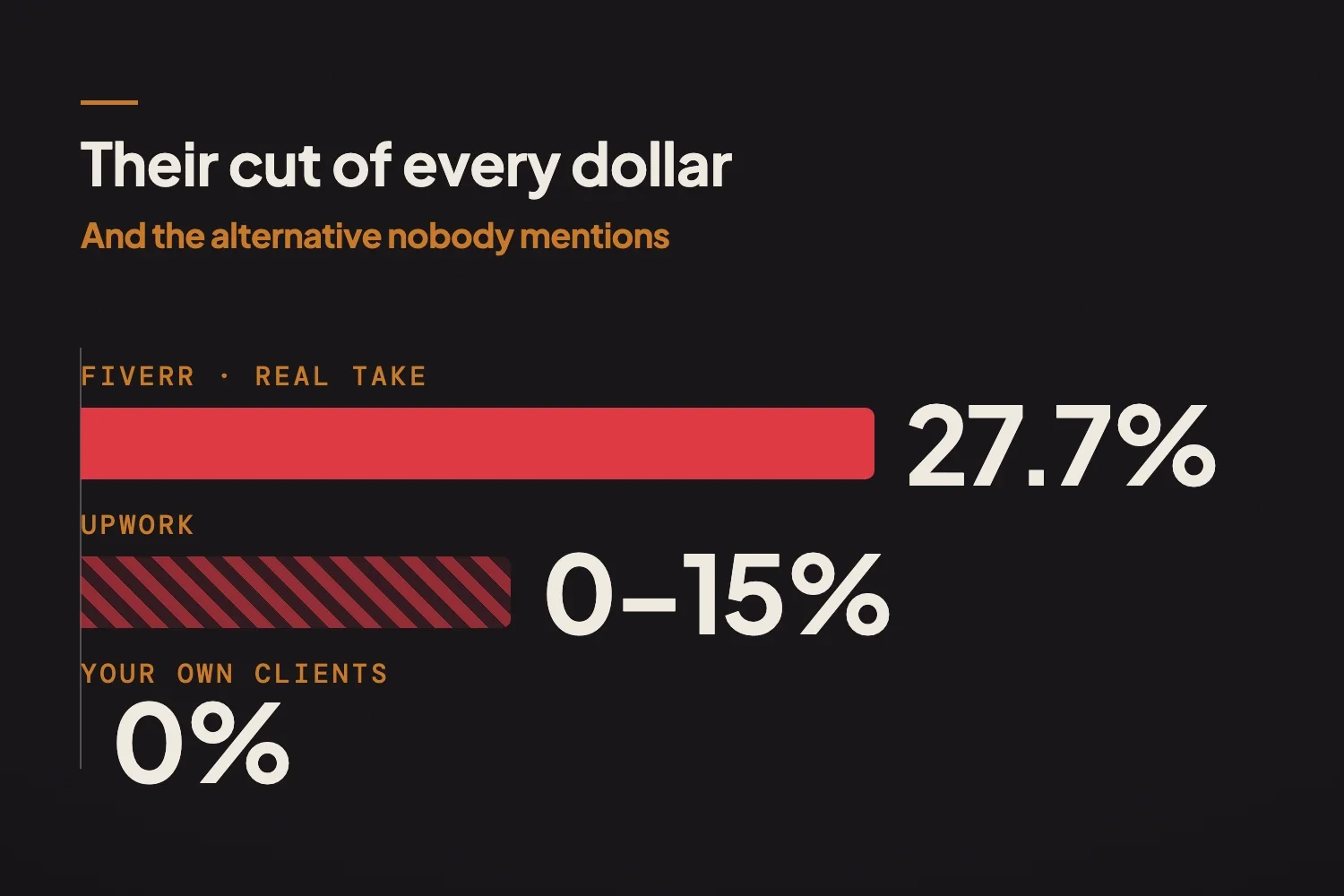
The honest list of Fiverr alternatives is short: Upwork (a different model but the same commission logic), the smaller clones, the curated middlemen like Toptal, and Contra (0% seller commission). All of them still rent you your own clients. Fiverr's real take reached 27.7% in 2025, so the strongest alternative is leaving the marketplace model entirely.
If you go looking for gig platforms, the same names come up again and again. Here's how each one differs from Fiverr:
Alternative | Model | Seller commission | The catch |
|---|---|---|---|
Upwork | Proposals, not gigs. You pay Connects to apply. | 0% to 15%, per contract | A shrinking pond: 784,000 active clients in Q1 2026, down from 832,000. See Upwork vs. Fiverr. |
Fiverr clones | Freelancer.com, PeoplePerHour, Guru: the same gig-and-commission model. | Included | Smaller client pools. A quieter marketplace, but the same rent. |
Curated (Toptal) | Agency-style screening and placement. | Built into the client's rate | The middleman owns the client relationship and can charge undisclosed fees, opening a gulf between what you're paid and what the client pays. |
Contra | A marketplace with no seller commission. | 0% | Still a walled garden: your profile, messages, and clients live under someone else's rules. Rarely wise to build on rented land. |
These options share an underlying model: a marketplace standing between you and your clients, charging rent on the relationship.
My view is that this business model is the expensive part for freelancers, and the clearest way to see it's to walk through what Fiverr says it gives you in exchange for that 20%.
This is the big one, and it's true as far as it goes: Fiverr reported 3.1 million active buyers at the end of 2025. It also reported that the number was 3.6 million a year earlier, a 13.6% decline. Those remaining buyers are shared across a global pool of sellers, and they arrive sorted by price, comparing you against a wall of near-identical gigs. A Priceonomics analysis of real income data found the median Fiverr seller makes about $60 a month - and that dataset is from around 2016, before the marketplace got more crowded.
Now compare what "clients being there" looks like on the open market. A sustainable freelance business doesn't need three million buyers. I've found that a roster of roughly 5 to 20 repeat clients keeps a full-time practice booked. And you choose them based on their fit with your offering, rather than waiting to be chosen from a wall of avatars based almost entirely on price.
Everyone knows client nonpayment is a genuine risk that freelancers face, and escrow can provide real protection. But read the fine print on what "protected" costs. The biggest issue is whether or not these gig platforms actually agree with you that the payment is owed. Poke around on Reddit etc and you'll find plenty of horror stories about clients claiming the work was bad, incomplete or some other fabricated grievance to get out of paying the bill. From what I've seen, the platforms side with the client far too often, including cases that appear to be clear and obvious fraud. Every penny of gig platform revenue comes from the clients - they're the platform customer, while the freelancers are the product - so it's not that shocking to hear that their policies favor those paying clients. Just be aware that their concept of "protection" may not match your own, and it's not uncommon for freelancers to be stuck with an unpaid bill and zero recourse.
The open-market freelancer enjoys arguably much stronger protections - a signed agreement and a deposit before work begins, the ability to issue a cease and desist order to clients who use unpaid work, and the ability to sue in small claims if clients don't pay. Those legal protections keep improving too - California's Freelance Worker Protection Act makes it one of many US states that now puts written contracts and payment deadlines for freelance work into law, and its protections have real teeth.
Just ask a working Fiverr seller how much time they spend on marketing. Gig titles are keyword research. Gig images are ad creative. Rankings shift, and sellers rebuild their storefronts every time the algorithm changes its mind. That's marketing - unpaid and perpetual, aimed at an audience of price-shoppers.
Marketing a niche practice is a smaller job, done better. When you serve one specific industry, you know exactly which fifty companies you want, what they read, and where they gather. Outreach stops being a megaphone and becomes a short list of well-researched conversations. If you haven't defined that niche yet, Niche Navigator is the free toolkit we built for exactly this - it maps your skills and background to niche industries where they command a premium.
They do build a reputation - Fiverr's. Your five-star record lives on a profile you can't take with you, inside a system you're contractually barred from routing around: Fiverr's off-platform policy requires communication and payment to stay on the platform, and accounts that move business off it risk permanent suspension. Don't think this is an obscure risk - over the last five years I've seen hundreds of posts on Reddit and elsewhere from freelancers who had their accounts terminated for minor infractions (or even NO infractions) due to the overly aggressive ai that Fiverr and other platforms employ to sniff out violations. Those freelancers no longer have a business, and must start over from scratch. Just imagine how that would feel.
The asset you spend years building isn't portable, and using it to leave is against the rules.
Joining is free the way a casino's drinks are free. The visible charge is the 20% commission, plus the 5.5% service fee your buyer pays at checkout - money that comes out of what they were willing to spend on you. The full picture is in Fiverr's own filings: a marketplace take rate of 27.7% for 2025, meaning the company captured almost 28 cents of every dollar that moved through the marketplace. For a full-time seller, that's roughly a quarter of a career, paid out forever, in exchange for the four benefits above.
If you got your start on Fiverr, you did what made sense with the options in front of you, and whatever early reps and portfolio pieces you got out of it are yours to keep. Staying past that point is where the math turns against you. Here's the thing: the strongest Fiverr alternative on this page is a business model, and it's the one I've run for 25 years and now teach. It looks like this:
Pick a niche industry. One specific market you can genuinely learn, in place of "anyone who needs design."
Identify its pain points. The recurring, expensive problems businesses in that niche actually complain about.
Productize your solutions. Package your skills as ready-made answers to those specific problems, with a core offer plus complementary services that drive upsells.
Build a small repeat-client roster. Approach hand-selected prospects directly, deliver the kind of consultative value a marketplace listing can't, and let repeat business and referrals gradually replace prospecting.
No commission, no clearing period, no ranking algorithm, and no terms of service standing between you and your clients. The trade-off is honest: this takes real work up front, and it's slower than listing a gig tonight. It's also the difference between running a business and running on a treadmill.
If you want to start, start where the model starts. Niche Navigator reads your skills and experience, maps the niche industries where they command a premium, and helps you dig into the pain points and solutions that become your offer. It's free to try. And if you want the full economic case on the platforms before you decide, the numbers are assembled in one place in Are Upwork and Fiverr Worth It?
It depends on what you want to change. Upwork changes the working model (proposals instead of gigs, with a variable 0% to 15% commission); Contra removes the freelancer commission entirely but keeps your client relationships inside its marketplace. For building a durable full-time income, the strongest alternative is leaving the marketplace model and building a small roster of direct, repeat clients around a niche you know deeply.
Contra charges freelancers 0% commission and earns its money from subscriptions and client-side fees instead. Keep in mind that the commission is only one cost of marketplace freelancing - discovery, communication, and payment still run inside the platform's rules, and your reviews stay behind if you ever leave.
Sellers pay a flat 20% commission, and buyers pay a 5.5% service fee at checkout plus a small flat fee on low-value orders. Fiverr's own 2025 financial results report a marketplace take rate of 27.7%, which is the share of every marketplace dollar the company captures.
Specialize. Choose a niche industry, learn its recurring pain points, package your skills as ready-made solutions to those problems, and approach hand-selected prospects directly; repeat business and referrals then replace prospecting over time. The free Niche Navigator tool maps your skills to the niche industries where they command a premium.
Put this into practice with the Freelance Mentors toolkits.



This article lives in Start Freelancing, the first stage of the Freelance Mentors expedition.

More guides and free toolkits to get your bearings on the fundamentals of freelancing.
Return to the hub
The full guided ascent: 120+ lessons, the complete toolkits, and mentorship from first client to thriving business.
Explore the program
My free Saturday morning newsletter delivers freelance wisdom and advice straight from my own personal experience and research.
It’s short and sweet but nutritionally dense - the perfect complement to your weekend morning coffee.
No fluff, no spam. Unsubscribe anytime.