Lots of people are asking "is Upwork dying" these days. Poke around and you'll find two kinds of answers: doom posts from freelancers whose pipeline dried up, and reassurance from deeply entrenched gig workers who aren't seeing the problem. Neither camp is wrong - Upwork's own published numbers tell a more interesting story than can be told in a one-sided social media post.
Upwork isn't dying. It's contracting, and in response, it's shifting priorities. Upwork's own filings show active clients falling from about 832,000 at the end of 2024 to roughly 784,000 as of Q1 2026 - a decline of around 6% in a year. Over the same stretch, the money each remaining client spent went up, with gross services volume per active client rising about 7% year over year. So fewer clients, but each spending more. That's a company deliberately shifting toward bigger accounts and enterprise work, not a company collapsing.
What do Upwork's actual numbers say?
Here's what the company reports, in one place.
Metric | What Upwork reports | What it means for a freelancer |
|---|
Active clients | 832,000 (end 2024) → 784,000 (Q1 2026) | Roughly 6% fewer buyers in a year, and flat since. A shrinking pool of clients. |
|---|
Spend per active client | Gross services volume per client up ~7% YoY (Q4 2025) | Good for the platform; not great for a solo generalist hoping to bid on smaller jobs. |
|---|
Freelancer service fee | Variable 0% to 15% per contract, fixed once the contract starts | Your take-home now depends on which contract you land. |
|---|
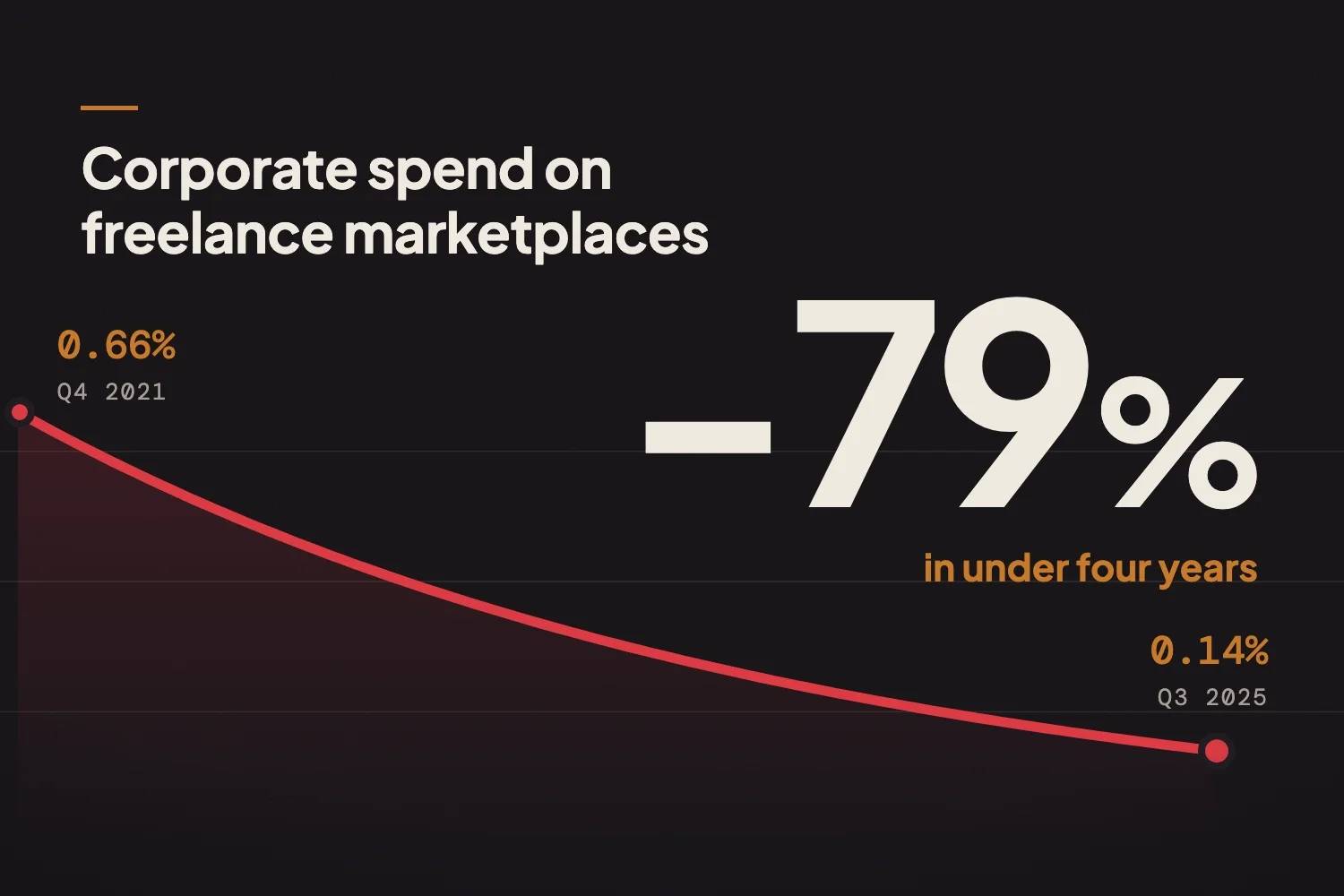
Where corporate money goes | Among companies using Ramp, the share of business spend going to freelance marketplaces fell from 0.66% in Q4 2021 to 0.14% in Q3 2025 | Businesses are routing a smaller slice of their budget through marketplaces at all. |
|---|
Read those four rows together and the shape is clear. The company is adapting - fewer, larger clients, and a fee structure that hoovers up your earnings wherever they can.
Upwork may be doing fine. But that's a separate question from whether you're doing fine on Upwork.
Where did the work go?
Some of it went to AI, unfortunately. Within less than a year of ChatGPT's release, postings for writing gigs on freelance platforms fell roughly 30% relative to manual-intensive work, while other roles that are at risk of AI displacement (coding, etc) fell about 21%. Those are declines in gig postings, not in what freelancers are getting paid. The actual pay effect measured on Upwork was much smaller: roughly 2% fewer contracts and about 5% lower earnings.
The Ramp data hints at where the budget went instead. Among the companies in that dataset, spend on AI providers rose from essentially zero to nearly 3% over the same period that marketplace spend fell from 0.66% to 0.14%. Businesses didn't stop buying help. They started buying a different kind of help for the commodity end of the work.
And on Upwork itself, the demand that's growing is specific: skills that explicitly reference AI grew 109% year over year, according to Upwork's own marketplace data. In other words, the platform isn't emptying out evenly.
So what is it actually like on Upwork right now?
Here's where reality and perception may diverge:
Reality - fewer clients, bigger clients, a variable fee up to 15%, and Connects that you buy in order to apply for work you may not get.
Perception - I've spent the last 6 years working directly with freelancers on Reddit and other platforms, and the perception I've observed from them is clear - being a generalist on Upwork (and most other platforms) has gotten meaningfully worse, and the cause is simple arithmetic. When the client pool shrinks and the freelancer pool doesn't, every job posting draws more bids. More bids means more price pressure, more Connects spent per win, and more of your working life spent on unpaid proposals. The treadmill speeds up, and you have to run harder to stay in the same place.
This isn't a case of Upwork being evil, it's just what happens when supply outruns demand. Marketplaces don't exist to protect your margin - remember, the paying clients are the platform's true customer, while freelancers are the product.
Does that mean you should quit Upwork today?
If Upwork is currently paying your rent, quitting it this week to "go direct" with no pipeline is a fine way to end up broke and back at a day job. What the numbers above describe is a slow, structural squeeze. Not a cliff you fall off next month, but a floor that keeps tilting. You have time to act, and you should use it, because the freelancers who get hurt are the ones who wait until the pipeline stops before they start building the alternative.
Use the platform for what it's good at. Build your exit while it's still a choice rather than an emergency.
What to build instead, starting now
My advice is to run two tracks at once. Keep earning where you earn today, and spend a slice of every week building the practice that doesn't depend on a marketplace. That practice has four parts, and they go in this order:
Pick a niche industry. One specific market you can genuinely learn - "independent physical therapy clinics," not "anyone who needs a website." Specialization is the whole answer to the AI-pressure data above: the work getting repriced is the work that can be described without naming an industry.
Learn its expensive, recurring problems. The things businesses in that market complain about every quarter and pay real money to fix.
Productize your solutions. Package your skills as ready-made answers to those specific problems, with a core offer and complementary services rather than an hourly menu.
Build a small roster of repeat clients. Approach hand-picked prospects directly. Five to twenty repeat clients will keep a full-time practice booked, and repeat business plus referrals gradually replaces prospecting altogether.
Two free toolkits handle the parts people get stuck on. Niche Navigator reads your skills and background, maps the niche industries where they command a premium, and works with you from niche to pain points to a productized set of services. Pricing Compass works out what you actually need to charge once healthcare, retirement, taxes, and unpaid time are in the math - which is usually the moment a freelancer realizes what platform rates were really costing them. The full method is laid out in how to find your freelance niche.
The honest answer
Is Upwork dying? No, not yet anyway. It IS shrinking as a place for freelancers to find work, however they're combatting this by growing more profitable per client (at who's expense?) and that combination will keep them solvent for now.
The better question is this - what happens to you if the marketplace keeps thinning for another two years? If that thought is uncomfortable, act on it while you still have the runway to course-correct without too much pain.
For the full economic case on both major platforms - fees, earnings data, what the research actually shows - the numbers are assembled in Are Upwork and Fiverr Worth It? And if you want the practical version of leaving, start with my platform alternatives article, which walks through what you'd actually be replacing.
Good luck out there.